Wednesday, November 13, 2013

Online Advertising - Blogs 11/13/13 & 11/17/13

Ok, we are now starting on week eleven of my Social Media for Business class, and I feel like a long distance runner who has just hit the “runner’s wall” – you know that physical and mental struggle their reported to feel when the runner needs to make it through those last few miles of the race.

It's becoming a long semester for me as I try to finish this class and others, while also preparing to try to reenter the work force. After a long hiatus from the working world, I have been buried within the world of College Academia. And I frankly have just realized I am tired of toiling with the academia - it’s time to put all this marketing management theory into some  more practical applications and start performing in a real marketing job.  

Anyway enough of my venting – I’m sorry - I know it is almost over. I will hopefully soon find some work, and then I will be complaining about how I wish I was back in school again.

So back to the Social Media Blog for this week; where we are studying about using Facebook Ads, and other online advertising options; which are now generally available at a lower cost than traditional advertising, to promote our business or other organizations online.     

As I have covered in some earlier blogs, where we had learned from the first few lessons of the social media class; we must always keep in mind our consistentbranding (online/offline) with themes, colors, text, and brand aesthetics; as well as practice the principles of using good web designs.  

It has been said that the use of Banner Ads are becoming the dinosaursof online advertising. Banner ads are advertising boxes (like an online Bill Board) used when you use a separate ad server to drive traffic and promote your products or brands/business through the use of embedded text and/or graphic images placed onto a separate webpage.  

When a consumer clicks on the advertisement (banner) it will take them to a landing webpage - usually the marketer’s business home page or their product and service pages.   Many feel this is a “content interruptive” medium - which is going to go slowly extinct over the coming decades as the use of more “native advertising methods” are becoming more popular; such as with Facebook or with Twitter advertising models.  

 Native Advertising” is defined in our class lesson this week, as the use of photos, articles, or videos, that “blend in with the overall social platform” - they are placed strategically to fit in with the discussions (within the community), and are related with the overall social content.  

As Social Media is constantly evolving, so should you and your business with the use of more Native Advertising on all your news feeds and social media channels.  

Your ad content  as well as your user generated - native advertising – should address some actual user concerns and provide some solutions to their problems, as well as introduce and provide introductions to your products/services.  These “conversations in real time” are also made into “personal endorsements” when other users (i.e. Facebook friends) are described as using them or shown to be endorsing or recommending your brand.    

Twitter is also a good low cost way (tool) to advertise your organization or business, and can help to tie all your different Social Media Channels together; as well as drive in more (new and old) customers, or web traffic to your other social web places.      

Twitter is also becoming more popular - maybe even more popular than Facebook with the younger audiences; although Facebook is still growing and gaining popularity with many followers or users within the older demographics or from earlier generations (over 40).  

Today I will be highlighting some of the Facebook and Twitter Advertising options that are available online; as well as cover some of my past and current plans or ideas for using Twitter and Facebook Advertising Platforms for the Sabrina Keller Foundation:  

As I had discussed in an earlierblog, Twitter is a good place to do market research and promote your business or drive traffic to your website and other social content such as on Facebook, Pinterest and others.  

As I had discussed you can use Twitter to do consumer research and learn how to grow organically by listening and joining the consumer conversations that are related to your business or industry. Make friends by following others and creating your own “followers” through tweeting about your business and relevant consumer social content. Another way to grow your business/organization is through Twitter’s paid advertising platforms and creating some “Calls to Action.”   

Twitter uses a “Pay-Per-Click” model for their paid advertising programs. They offer three features for reaching out and engaging twitter users with “promoted accounts”, “promoted tweets”, and “promoted trends.”   All the advertising is marked “promoted” so twitter users can distinguish them from the regular organic social content. It is a low cost option with their pay per click billing methods as compared to other online advertising such as with Google Ad words (search listings).  It also has key target consumer features that are excellent for reaching only those twitter users who are most likely going to be interested in your products, services and brands.  

The “Promoted Accounts” option is a good way to increase your Twitter Followers (but it is a bit more costly form of advertising than just using daily organic tweets), and to promote your brand name/business, products and services, or organization.   

The promoted accounts feature displays informational widgets and will link your account name on another Twitter user’s homepage as a display with suggestions on “Who to Follow.” When you create a largertwitter following – you create a solid consumer base – and you can begin to better maximize the powers of exponential social marketing.   

Promoted Trends” are the most expensive advertising feature on Twitter, and it allows a larger marketer to be able to display “consumer trends” or topics, which they can choose to promote and the can be seen system wide on all the Twitters users homepages/feeds.  

Promoted Tweets” is the most prevalent advertising tools available- they will act just like regular organic tweets within the twitter news feeds, but they have some added perks with more targeting and timing capabilities and with consumer reach; which can act better to increase your possible consumer engagements or calls to action. 

The Sabrina Keller Foundation is a nonprofit and has little money to spend on paid advertising methods online or off. Most promotions in the past have been through the use of organic tweets about upcoming events and educational information (usually through Facebook posts). The following screen shot is how the Sabrina Keller Foundations has made use of twitter recently at no cost organically:   


 The following is a proposed ad I will present to the SKF”s Board and utilize if they chose to make a paid announcement – a promoted Tweet for an upcoming event in February 2014.  

With this this ad I would utilize a “Key Word” targeting strategy -  using key words such as bowling, family fun, parents, kids, and fund raiser among several others (key words) to target people who are interested in these topics and are also  located in the  San Diego or Los Angeles Metro areas.  I would propose we spend no more than twenty dollars total budget and try to reach a goal for gaining one or two user engagements each day (about $1.50 per click) during the coming weeks prior to the event. It would be a personal donation by me and an experiment to find out if the use of a paid tweets strategy could benefit the SKF Foundation in the long term.  

Facebook also has several types of no cost or low-cost - paid advertising options that the Sabrina Keller Foundation might want to experiment with over time.  

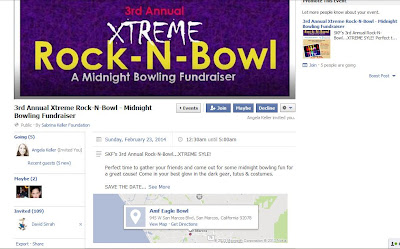
The Facebook Ad is the most obvious one to start with - which will usually be seen on the right hand side of your traditional personal Facebook profile/page and news feed.  They are straight forward ads and will usually make no attempts to be like native advertising – and will not necessarily pertain to the current discussions or social content.  It will often be linked to some external organization’s homepage or a Facebook business page.  Here is an example of a Facebook ad I could create for SKF and their upcoming Annual Bowling Fundraiser:

It would link to our Facebook events page as follows:


The second type of advertisement you can make on Facebook is called the “Sponsored Story.”  When a fan or user has engaged with one of your existing ads, it will also appear in their friend’s news feeds as an ad or brand that their friend has already liked or endorsed; thus increasing your reach and possible engagement further out into the Facebook community.  The following is an example of a sponsored story as depicted by HubspotMarketing:
 
A third form of Facebook paid advertising is the “Promoted Post” – a promoted post is when you promote an existing post, image, current event, or social comments and announcements, etc. - it can help send page visitors - people back to your older content further down on your page feed.
If you’re using any of the numerous specialty apps available by Facebook – you can promote those business or sponsored apps you have available to your fans; as well as create user-fan stories or advertisements about your users who are engaging with them – with their personal endorsements then appearing on their friends/networks news feeds or profile pages.   

Finally there are paid Event Sponsorships – where you can pay to have your events promoted to those Facebook users most likely to attend an event like yours.  


The second half of this week’s assignment – with our second blog which I have decided to combine here into one blog for this week’s assignment - was to talk about how to use these Facebook and Twitter advertising applications more organically; for when we do not have much for spending money and cannot create larger advertising budgets.  

As I had already displayed above the Sabrina Keller Foundation has created calls to action with their Facebook posts; which asked our followers to download an event flyer and pass the word on to others through more word of mouth communications.  This call to action cost us no money and was posted frequently as needed to get our followers attention over the coming weeks up to the Panda Express event. 

I have also included some screen shots (below) of some other messages I have posted and some of our other social content which was posted over the past few weeks which cost us no financial resources except for some of the minimal time I needed to create them:   

Social Content:


Calls to Action:


Wednesday, November 6, 2013

When Your Customers Need to Know More: Fill Them in With an Email Blast

Email Marketing can be a very important part of your Business or Organization’s (Social Media) Marketing Mix.  According to this week’s lecture in my Social Media for Business Class - sending out emails can fill in the gaps where your other social media efforts might miss. It can drive online (as well as off) traffic to your web content, and inform them about your business’s products and services, relevant news, goals and other types of events.  

According my class professor’s notes, consumers who receive email marketing (opt in) spend about “83 percent more while shopping” than customers who do not receive any email marketing announcements at all. On average their sales orders are larger by about 44 percent, and they will place orders 28 percent more often than the traditional shopper does.   The average return on a business’s email marketing efforts is about $44.25 in sales per every dollar spent. Seventy two percent of business marketers think that email engagement and advertising makes a good value with their return on (marketing & promotions) investments.  

There are many email platforms (software sites) online that will provide mass email marketing tools, as well as analytics and information for monitoring your results. They can vary in prices and functionality with their services, from the simple and free, to more complex and expensive, depending on your business’s needs and size (contact lists). 

Many of them will provide email (newsletter) design tools (templates) for better aesthetics and functionality – making your emails more appealing to your customers. The more professional you can look with your branding (newsletter - emails), the more responses for your email marketing efforts you will most likely get.  

With your emails you can create Calls to Action to visit your web pages (landing pages) online or your social media pages such as Facebook and Twitter (or others). You can invite them to join as followers or tweet about your business, news and other events. You can promote sales opportunities, offer promotions, and advertise events; or even just remind them of your online presence when things are getting slow and not much is going on at the moment. 

It is an excellent tool for building relationships with your customers. You can invite them to join your lists online or off (with post cards or registries) at trade shows, business events, or your brick and mortar locations (such as when their at your sales desk).  

These newsletters can be sent out semiannually, quarterly, monthly, weekly, or even daily depending on your business needs and customer’s receptiveness. Be sure to offer them easy to find opt-out opportunities, and be careful of privacy and spamming your consumers; you do not want to appear unprofessional or anger people who are not interested. 

Turnover and churn are a part of the business cycle, so let those customers who aren’t interested go, and you will keep your brand stronger in their minds as being respectful and conscience of their security. This might help you woo them back in the future when the timing is more relevant to their needs.  

My assignment for his week was to think about my consumers for the Sabrina Keller Foundation and what type of newsletter would I choose for the organization. Should it be sent daily, weekly or monthly or perhaps quarterly is more appropriate?
  
As of now the Sabrina Keller Foundations has sent out an informal email message when there is an upcoming event for a fundraiser or family dine-out which is usually about 4 to 8 times a year. The rest of the year Facebook is the most often website – or marketing strategy for consumer engagement.

I would propose The Sabrina Keller Foundations organize a Bi-monthly schedule for a newsletter that would talk about several topics including upcoming events such as our “dine outs” – which are held at local participating restaurants like Panda Express or Applebee’s.

Other topics of interest to engage our subscribers would be the Girl Scouts activities and events they may have in the local area. We could highlight individual girl scouts with their member awards and other community projects they may be working on. 

The Keller Foundations also holds family events, such as bowling nights or horseshoe games/picnics - that we can promote in the newsletter - as well as highlight them (pictures/activities/awards/fund raising statistics etc.) afterwards.

Educational Articles about the SADS and the SADS Foundations could be reprinted in the newsletter, as well as highlight those families struggling with the disease; either from the loss of a child or of those families who are coping with a related SADS illness. Perhaps we could place recipes for hearth healthy cooking or an article on how to have every day family fun – such as from a reprint a Family oriented magazine – article. 

I think these topics would all be relevant to the Sabrina Keller Target consumer, who are generally woman between the ages of 25 – 65; who are parents- mostly mothers of children and adolescent-teens.

Sunday, November 3, 2013

What's Your Organization's Topics? - Stay Focused With Blog Categories!


Today my blog is about creating blogging “Categories.” According to my readings in the Social Media Book “Get Up To Speed with Online Marketing” (by Jon Reed), and my Social Media for Business class lecture for the week; “Categories” are a way to keep your blog organized and stay more focused. 

The categories I speak of today in this blog should not be confused with the categories that are described in Google Analytics. Google Analytics defines categories in relation to webpage “Events,” which are different types of actions a page visitor-user makes on your blog or other websites. Such as clicking an ad banner, using flash components, or playing an embedded video you have placed on your page. Categories within Google Analytics would be the element that you’re analyzing for user engagements – such as a video vs. an advertisement (which are two different categories). 

The categories I speak of today should also not be confused with “tags” – which are even more detailed words used to describe subcategories – in which you are drilling down into a topic and breaking it up into many pieces (See Google Analytics & Word Press Help for more details on their definitions of tags and categories). 

Your blog can become more successful with target market reach and engagement, if you can define it into a few broad topical categories. Which will not only help your readers find you, but they will also give you a way to keep your writings better focused on your relevant topics from week to week. As well as it might remind you and give you some ideas for what to write about when you are having difficulties with developing your written content. 

Which topics – well-chosen words - will make the most sense to describe your written materials for your audience? So that they may find your blog easily based on the topics of interest their searching for online. 

For my social media class projects this semester I have been learning and managing both the social media needs for a nonprofit organization called The Sabrina Keller Foundation; as well as writing this personal class blog (and a Facebook page) to create some social media presences as a personal branding tool for my own personal career endeavors. 

Although I have not written a blog for the Keller Foundation project specifically, I will define some “Categories” in which I would place the organization for blog topic(s) if the Foundation had chosen to develop one.  

I thought The Sabrina Keller Foundation could be labeled into six (6) broad categories such as SADS- (Genetics & Heart-Health Education), Non Profits, Girl Scouts, College Scholarships, and Families. 

I of course could have come up with several more topics the Foundation might choose to write about. But according to a recent blog reading I found online (ProBlogger) the fewer categories in a category list; the better it will be for not confusing your readers with a lot of clutter and topic choices. There are many times that a blogger will often go off topic (and add the category) and their categories list will get too long and eventually they become irrelevant to describe the most often written subjects. They recommend that if you have a lot of categories in your existing topics list, look for your categories that are “superfluous,” and combine them into one or emit them altogether.  

The reason why I think these six categories could help the Sabrina Keller Foundation grow and stay organized with their topics is because they all stress the foundation’s mission, which goes beyond just SADS (Sudden Arrhythmic Death Syndrome) Education and College Scholarships for Girl Scouts. It is also based on their goals of having “Family Fun” at all their fundraising events. So I  imagine blog topics of course would revolve around SADS education and information, Girl Scouts and College Scholarships, Heart Health Education,  as well we would probably write about how the family could have fun together.

These would all be topics of interest for our target markets – which is generally families, or parents and mothers – mostly woman between the ages of 25 to mid-fifties - with adolescent children,  or teenagers and their families.

For this blog – my personal branding blog - I had placed the blog within the Google Analytics “Industry Category” of “Business and Industrial Markets,” as my personal blog pertains to my career goals for becoming a Marketing Communications and/or Service/Product Marketing Manager. I could have also possibly placed the Personal Brand Blog under ‘Jobs and Education.”

If I was to create a category list directly into my blog on Blogger – I might also label it under Marketing, Business (Education), Career Development, Social Media, and Human Resources. My target audience is going to be Human Resource Mangers and/or Marketing Professionals who might be able to help me find work or provide opportunities for business networking. 


Posts I have commented on:


Social Media for Business
I blog about Social Media and the like

Thursday, October 31, 2013

Business Blogging with "Personality" - Should You get Personal or Professional

Today’s Social Media for Business topic is about how should you maintain a blog for your organization; and just how personal should you or the blog be with your written or visual content?

Should you or can you be relaxed and talk in the first person - from a more intimate sort of view? -Revealing your personal opinions and emotions or experiences?    

Or are you possibly working on behalf of someone else, and you will need to keep a written voice that is strictly professional. This week with my social media class lecture - our professor tells us it depends on the business of course - and what your particular goals are going to be. 

Who are your more relevant consumers or customers, and does the business environment allow you to show off some of your organizations personalities to them? Maybe you can engage your online consumers through certain company personnel or some other prominent individual? 

Perhaps a blog can be written by the owner of the business, or the CEO of the company?  These are a few of the key players in a business that might act as a less stringent voice for the company – showing a more human side for the organization, with which you can possibly create more consumer engagement.    

Personally I have a hard time with getting too personal on a blog such as this. Although I am a younger baby boomer – a baby boomer I am. So not being like most millennials, I do have some reservations about having to display personal pictures or for telling my life’s stories online. 

I am just now warming up to the thoughts of keeping a limited social  media presence online with developing my  “personal brand” - which is intended to help develop my professional career track, and maybe in time, to try to achieve some personal business endeavors.  

But it makes sense to get more intimate to attract people; especially if you’re a business owner who can adopt an online presence for your company.  I just saw a commercial on television for a used car dealership in Vista California, called Classic Chariots. The owner of the company is the face of the organization, and he regularly appears on local cable television; encouraging people to find him on his Facebook and Twitter pages. 

It was engaging for me as a consumer to go online to see his Facebook page, as I’m currently in the market for a new used car. I think if he maintained a blog emitting the same eccentric personality I see on TV, he would be very successful with a blog too - complementing his already very savvy social media presence.  

Sunday, October 27, 2013

Twitter for Marketing & Business Research: Create Beneficial Relationships

This week my Social Media for Business class is covering the utilization of a micro blogging website called Twitter.  Our professor points out that Twitter can be quite valuable for you as a business marketing tool. 

Contrary to some people’s opinions that Twitter seems like a complete waste of time for teenagers, or that it seems contrite; as they hear about people who are tweeting what they have had for breakfast. We actually need to take another look, think about our brands, and drill down into what is being said by these consumers in their tweets and on their twitter feeds. These tweets can actually provide you a way to listen to people, and to reach out to some industry thought leaders, as well as do some free marketing research.  

Those every day seemingly mundane types of tweets are coming from your current and maybe even more importantly your potential customers. These everyday tweets can become the most valuable information for you as a social marketing communications manager, to create some positive consumer engagement and possibly increase your profits.    

For those who do not know how Twitter works; it is a micro blog where you are limited to only 140 characters or less of written text within each post or tweet (as they are called on Twitter).  Within these tweets you can put any kind of quick or short message:  an advertisement, links to articles or other websites, and even graphic images. You can create a personal or organizational profile and you can follow other people/topic profiles which are of interest to you.  You or they (Twitter profiles) can represent either a business, organization or a single person.  

All tweets are public information except for when you send direct messages (DM) to followers, which are between you and one follower.  Even though these DM’s will not be seen on other peoples (your other followers) Twitter feeds, they will still appear on your profile wall.  When someone uses your @username in their Tweets it is called a “mention.”   If you put @someone’s user name at the very beginning of your tweet – (but not within the middle of the tweet) - it will only be seen by that user and it will also appear on your profile.   

There are design options available for your profile’s appearance to help you develop and complement your branding with other websites and offline.  You can include #hash tags for more search engine optimizations (SEO).  Refer to Twitter help for more details. 

Our class was instructed to use the advanced search tools available to find some related Twitter users or industry related organizations/key people – thought leaders - for our business to follow.  This is an excellent tool for a business owner or manager to use for consumer marketing research also. You can search key terms related to your business needs and find people who are interested and tweeting about them.  

For example my project business the Sabrina Keller Foundation has a fundraising event next week on November 6th – An eat-to-donate event at Panda Express in San Marcos California. Out of curiosity I searched the key words Chinese Food and Panda Express with the location of Escondido/San Marcos California (in separate searches). I found several users who said they liked Chinese food or were noted for eating at Panda Express. I could either passively follow them (to raise their curiosity about our organization), or aggressively market them for the event next week at Panda Express.  Or perhaps less invasive I could get in on their conversations – perhaps “retweeting” their comments and/or responding with my adding my own mention of the event at Panda Express next week.   

Another marketing strategy to adopt on Twitter is to find people or organizations related to your industry or brands and “follow” them - sometimes called “Influencers.” Hopefully you will be able to develop relationships with them online by creating and joining their discussions through Twitter over time.  

I searched the Key word terms “sudden cardiac arrest” and found several related organizations for the Sabrina Keller Foundation to follow including SADS – The National Sudden Arrhythmic Death Syndrome Foundation.   The group Parents Heart Watch, and another called Heartfelt Cardiac Projects - which is an organization in Orange County that holds regular screening events for adolescents and teens to get genetically tested for SADS related disease.  These are just a few of the heart health related organizations I found with these three words alone.  I searched for “children’s health” and I found Rady Children’s Hospital to follow also.  

Twitter even started to suggest some organizations to follow as it noticed my patterns for selecting them. After choosing some local media outlets that I thought might be good candidates to reach more people on topics about heart health and health care in general. I had searched the key terms “San Diego,” “health,” and “media” - and the results gave me a large list of local health organizations including Blue Cross and several not so related topics for me, but it also gave me PBS “woman’s health” listed as second.  Upon choosing that organization to follow I was suggested by Twitter to Follow CBS Channel 8, NBC 7, the San Diego Tribune and several others.  

I also searched the key terms Girl Scouts and followed the national organizations profile as well as the local San Diego and Escondido, San Marcos Chapters.  As they are major stakeholders in the Sabrina Keller Foundations goals - as we are raising scholarship monies for this particular group.

There are other tools available to utilize for organizing your marketing efforts on Twitter as well, including a list feature, which you can use to manage and organize or to separate those people you follow into identifiable groups. Such as “girl scouts” or “Chinese food lovers” etc.  That way you can easily find these people or organizations to target your marketing efforts daily as needed. 

My class professor also recommended using Twitter for finding content ideas either for retweeting or to use elsewhere like on Facebook.  One of the organizations you may be following might have a good article or some good ideas to learn from, and you can use them elsewhere to promote your business and better reach your business goals.